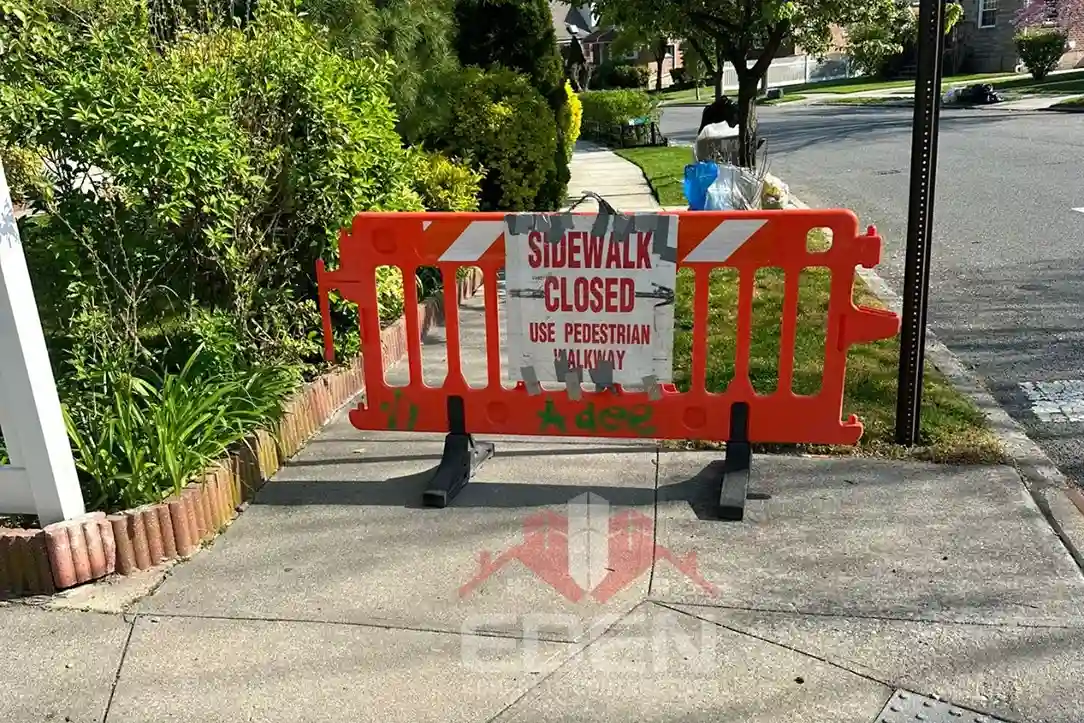
How To Avoid DOT Sidewalk Violations In New York City
If you want to avoid a DOT sidewalk violation in New York City, the best thing to do is stay ahead of damage. Check your sidewalk often, fix small issues before they get worse, use a licensed contractor, and make sure any repair follows NYC DOT rules. In most cases, the property owner is responsible for the sidewalk next to the property, and once a violation is issued, the clock starts running.
For NYC property owners, sidewalk problems are not just a maintenance issue. They can affect safety, delay a sale or refinance, and lead to city repairs that get billed back to the owner if the work is not handled on time.
Why sidewalk violations happen in NYC
New York City holds property owners responsible for keeping adjoining sidewalks in safe condition. That includes installing, repairing, repaving, and maintaining the sidewalk area next to the property. NYC DOT can issue a Notice of Sidewalk Violation when an inspection finds unsafe conditions.
Common problems that can trigger a violation include:
- Cracked or missing sections
- Uneven flags,
- Collapsed sidewalk areas,
- Improper slope
- Patchwork repairs
- Hardware sticking out of the walking surface.
Even relatively small defects can be enough to cause a problem. NYC 311 notes that holes as small as 1 inch or sidewalk flags raised by as little as half an inch can create hazards.
The easiest way to avoid a DOT sidewalk violation
The simplest answer is this: do not wait until the damage becomes obvious.
NYC DOT specifically encourages property owners to repair sidewalk conditions before they become defects that can lead to a violation. That means routine checks matter. If you own a home, mixed-use building, or commercial property in NYC, it is smart to inspect the sidewalk in front of your property on a regular basis and after winter weather, utility work, heavy delivery activity, or nearby construction.
1) Inspect your sidewalk regularly
Many violations start with damage that looked minor at first. A small crack can spread. A slightly raised flag can become a trip hazard. Water drainage issues can weaken the base under the concrete and lead to sinking or collapse later.
Walk the full frontage of your property and look for:
- Cracks and loose concrete
- Raised or sunken sidewalk flags
- Puddling or drainage problems
- Patchwork repairs from older jobs
- Exposed hardware or metal pieces
- Damage near tree roots, curbs, driveways, or cellar doors
These are the kinds of conditions NYC DOT highlights in its official sidewalk materials.
2) Fix small problems before DOT inspects
A lot of owners only act after they receive a notice. That is the expensive way to handle it.
Once DOT issues a violation, you have 75 days from receipt of the notice to make the repair. If the notice is not delivered by mail, the 75-day period starts from the posting date on the property. If the work is still not started and completed properly, DOT may arrange the repair and the Department of Finance can bill the property owner.
Preventive repair is usually easier than dealing with a formal violation, paperwork, inspection scheduling, and possible billing from the City.
3) Use a licensed contractor who knows NYC DOT rules
This is where many owners make mistakes. A sidewalk repair is not just a basic concrete job. It has to meet NYC DOT standards.
NYC recommends hiring a contractor familiar with DOT sidewalk specifications. NYC 311 also notes that any contractor doing sidewalk repair work costing more than $200 must have a Home Improvement Contractor License from the Department of Consumer and Worker Protection. DOT further recommends checking the contractor’s license status and complaint history before hiring.
That matters because poor repairs can fail inspection, leave the violation open, and force you to pay twice.
4) Make sure the right permit is pulled before work starts
A repair job without the right permit can create another headache.
According to NYC 311 and NYC DOT, the contractor must obtain a sidewalk construction permit before beginning the work. DOT also makes clear that getting a permit does not extend the 75-day deadline tied to a violation. The current permit cost listed by the City is $70 for up to 300 linear feet of sidewalk for one property, and corner properties may need more than one permit.
In plain terms, do not assume “we filed the permit” buys extra time. It does not.
At Eden Concrete Contractors, we manage the process from start to finish so property owners do not have to deal with the stress on their own. We provide the free estimate, schedule the repair, arrange the permit, and guide the job through the DOT dismissal process. Our goal is to give you one reliable team that handles the issue clearly and efficiently from the first step to the final resolution.
5) Know that a violation is not the same as a fine
A lot of owners misunderstand this point.
NYC DOT says a sidewalk violation does not carry a fine by itself. Still, it is serious. A copy of the violation is filed with the County Clerk and stays on record until the City confirms that the repairs were made properly. DOT also warns that an open sidewalk violation may complicate a sale or refinance.
So even though it is not a ticket in the usual sense, it can still cost you money and create legal and transactional problems.
6) Request a dismissal inspection after the repair
This step gets missed all the time.
Fixing the sidewalk is not the last step. After the work is completed, the property owner must request a Sidewalk Violation Dismissal Inspection through NYC 311. DOT says you should have the permit number, property address, block and lot number, violation number, and your contact information ready. The sidewalk also needs to be fully visible for inspection.
If you skip this step, the violation may remain on record even though the physical repair is already done.
7) Pay special attention to tree-root damage
Tree-root cases are one of the biggest sources of confusion in NYC.
For qualifying one-, two-, and three-family homes, the City may perform free repairs when the sidewalk is severely damaged by curbside tree roots. The City also says it no longer issues violations or imposes liens on one-, two-, and three-family properties when the damage is caused only by City trees. But this exception does not apply broadly. For commercial properties, co-ops, condos, vacant lots, and residential properties with four or more units, the owner remains responsible for repairing tree-root sidewalk damage through an independent contractor.
Also important: cutting or shaving the roots of City-owned trees is prohibited. NYC Parks offers consultations for property owners doing work around tree roots.
8) Be careful with driveways, corners, and special sidewalk materials
Some sidewalk areas are more complicated than others.
Corner properties may involve the intersection quadrant and pedestrian ramps. Landmark or historic properties may require additional approvals. Sidewalks made of granite, brick, slate, or other distinctive materials often need private repair rather than standard city concrete replacement. Sidewalks over vaults also require special attention because the City will not repair sidewalks over vault structures.
These are the kinds of cases where it helps to work with a contractor who has real NYC experience like Eden, not just general concrete experience. That is a practical takeaway from the City’s guidance.
9) Document damage caused by someone else
Even if another party caused the problem, you should not ignore it.
NYC says the property owner is still responsible for the sidewalk condition next to the property. If a utility company or another contractor caused the damage, the owner should document it and contact that party for repair or claims handling. DOT also provides a way to search permits issued for an address or area. Claims against utility companies should go to the utility’s claims department.
In other words, “someone else did it” does not stop a violation from becoming your problem.
What to do if you already received a DOT sidewalk violation
If you already got a notice, take these steps right away:
- Review the violation and the Preliminary Inspection Report.
- Confirm the property details and marked sidewalk flags are correct.
- Hire a licensed contractor who understands DOT specifications.
- Make sure the permit is obtained before work starts.
- Complete the repair within the allowed window.
- Request the dismissal inspection through 311 when the job is done.
If the report does not match the actual sidewalk condition, NYC DOT says you can request a re-inspection within 75 days of receiving the notice.
Final thoughts
Avoiding a DOT sidewalk violation in New York City comes down to being proactive. Check your sidewalk often. Do not ignore early cracks or uneven sections. Use a licensed contractor. Get the correct permit. Follow NYC DOT specifications. And if repairs are completed after a notice, always request the dismissal inspection.
That approach protects pedestrians, keeps your property in better shape, and helps you avoid the delays and cost that come with an open violation.
 Monday – Saturday: 8:00 AM –
6:00 PM
Monday – Saturday: 8:00 AM –
6:00 PM